
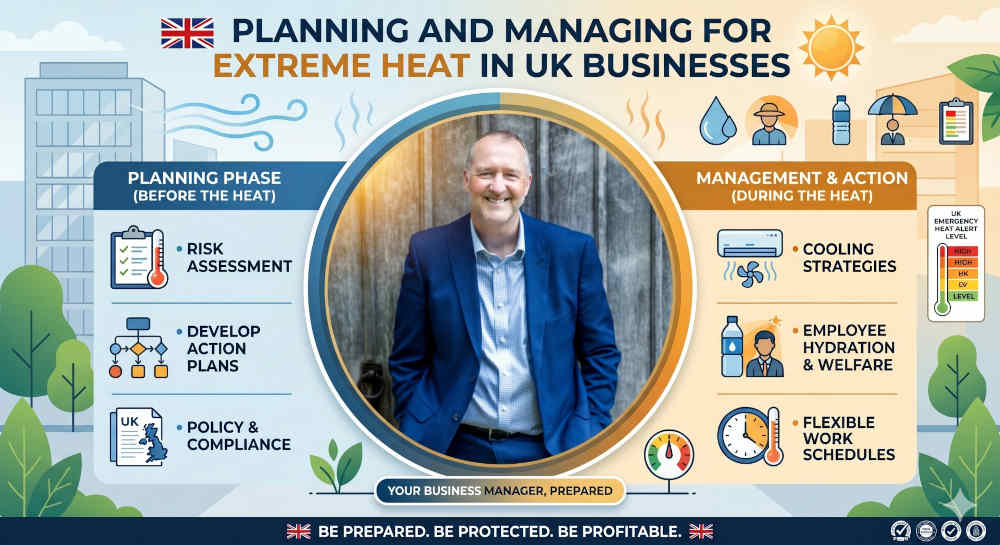
The current heatwave is ‘generally’ welcomed in the UK, but it has both financial and operational ramifications for manufacturing businesses. (N.B. It has been pretty toastie when riding my m/c – too hot for me.) I thought that this was an apt time to consider these impacts as it is expected that such events shall increase in frequency and hence business needs to prepare now.
For manufacturing, engineering, logistics, construction, food, print, care, hospitality and distribution businesses, sustained temperatures near to and above 30°C can create at least six business pressures:
- Lower productivity
- Higher labour absence and safety risks
- Transport and delivery disruption
- Higher energy, cooling and facilities costs
- Material, process and quality problems
- Greater supply chain volatility
So, let’s have a wander through these and tease out a number of things to consider and act upon:
- Labour productivity and workforce performance
Uncomfortably higher temperatures in general reduces human performance, particularly in warehouses, factories, vehicles, kitchens, workshops, care settings and construction sites. For me temperatures into the late 20’, sweltering 30’s and scary 40’s are a significant issue.
Operationally, this can result in slower picking rates, slower production rates, the need for more rest breaks, more mistakes, lower concentration, more rework and greater supervisory pressure. In practical terms, this means that a business could achieve fewer productive hours per head.
The Health and Safety Executive and UK Government confirms that there is no legal maximum workplace temperature in the UK, but employers must still control health and safety risks, and heat is treated as a workplace hazard. ACAS advises “employers are legally required to ensure “reasonable” temperatures for staff”.
- Health, safety and absence costs
Prolonged heat increases the risk of dehydration, heat exhaustion, fatigue, fainting, poor concentration and accidents.
For employers, the consequences are financial and operational: more absence, more near misses, more stoppages, higher insurance exposure, greater duty-of-care obligations, and potentially difficult employee relations if staff believe the workplace is unsafe or their employer is not worried about their well-being.
High-risk groups include outdoor workers, drivers, warehouse teams, machine operators, older workers, pregnant workers, agency workers and employees with underlying health conditions.
I see typically employers resulting to the provision of electric fans and AC (driving up energy costs), providing cold water supplies (bottles, plumbed water dispensers) and an “ice cream a day” to support their employees.
- Transport, logistics and delivery disruption
Extreme heat can directly affect road, rail, air and inland water transport.
Rail appears to be especially vulnerable, as railway tracks in direct sunlight can be up to 20°C hotter than air temperature. This heat can cause rail expansion, buckling, speed restrictions, delays and line closures. Our roads are already in a less than ideal condition and so for the tar to start melting, leading to more damage, is especially worrying for me.
For supply chains, this can mean late inbound deliveries, missed customer deliveries, higher overtime, greater use of premium freight, rescheduled installations, driver welfare issues and service-level failures.
Across Europe, drought and low river levels can restrict inland shipping. During recent European heat and drought periods, lower water levels on rivers such as the Rhine and Danube forced vessels to carry reduced loads, increased freight costs and disrupted industrial supply chains.
- Energy demand, cooling cost and power resilience
Heat increases electricity demand because offices, factories, data rooms, cold stores, care homes, hospitality sites and distribution centres require more cooling. Our energy grid can really struggle during extreme conditions due to increasing power demands and now spiking on these hot days as well ….
The commercial impact is clear: higher energy bills, greater risk of local power disruption, more stress on compressors, chillers, extraction systems, and HVAC, and increased maintenance callouts. Good for some businesses providing new installations, service and maintenance but a real drain for most consumers.
For procurement teams, this creates a need to review energy contracts, critical spares, backup power, investment in smart energy systems, HVAC servicing, refrigeration resilience and site-level energy reduction plans. Having a robust system in place to continually drive down power consumption should be on all businesses radar and now many should be considering options to generate their own power e.g. wind turbines and solar power.
For those businesses building new developments, there is a fantastic opportunity to consider the latest innovations in heat (environmentally) resilient infrastructure. Where the materials of construction and designs are carefully chosen and nature-based solutions are purposely integrated to create a wonderful workplace, that integrates with the environment, rather than taking from it.
- Production, quality and materials impact
In manufacturing and engineering environments, heat can affect both people and processes. Typical issues include glue failures, ink and coating behaviour changes, packaging distortion, expansion of materials, machine overheating, compressed air system stress, quality drift (unless you are lucky enough to operate in a controlled temperature environment), higher scrap and more environmental control problems. Strangely I find quality control measurement labs very popular during summer!
In print, packaging, electronics, plastics, food, pharma, furniture, chemicals and precision engineering, temperature and humidity control can become a quality-critical issue. If tolerances, curing times, glue performance, ink viscosity, stock condition or calibration are heat-sensitive, the business may see hidden cost through rework, customer complaints and reduced output. How is your business minimising these risks? Do you have a plan? A budget?
- Supplier performance and inbound risk
A heatwave affecting the UK and Europe may hit raw materials, transport, labour availability, port operations, agriculture, water-intensive industries and energy generation at the same time.
For buyers, the key risk is that Supplier On Time In Full (OTIF) performance may deteriorate just when customers are expecting normal service. Lead times may extend, hauliers may apply surcharges, suppliers may ration output, and alternative capacity may already be booked by competitors.
- Water scarcity and process continuity
Prolonged heat is expected to result in higher water demand, and you can bet that some burst water main pops up at the same time.
Businesses that rely on water for cleaning, cooling, processing, welfare, landscaping, hospitality, food preparation or washdown may face restrictions, rising costs or operational disruption.
This has direct procurement implications for water efficiency, rainwater capture, grey water use, cleaning specifications, cooling systems and supplier resilience.
- Financial implications
The main cost consequences include:
Direct costs: higher electricity bills, purchase of additional cooling equipment, temporary ventilation demands, bottled water supply (often refrigerated), PPE demands, maintenance callouts (the AC always fails now), overtime, premium freight, extra welfare measures and possible agency cover.
Indirect costs: reduced productivity, missed delivery slots, lower output, quality failures, rework, scrap, customer penalties, lost sales and reputational damage.
Strategic costs: need for capital investment in building resilience, HVAC, insulation, shading, solar control, water efficiency measures, route planning systems, inventory buffers and supplier diversification.
- So, what can purchasing and operational leaders do?
The immediate response should be practical:
Review and document heat risk by site, supplier, transport route and process. Identify which products, machines, people, materials and customers are most exposed.
Develop a ‘heatwave’ operating plan covering working hours, hydration, rest breaks, driver welfare, HVAC maintenance, critical spares, stock bualances, alternative carriers, customer communication and supplier escalation. As an example, foundries will avoid pouring metal during the day and switch to nighttime or alternative ‘midday’ avoiding shift patterns.
From a strategic procurement perspective, the priority is to move heat from being an “unexpected event” to a managed category risk. That means working with and supporting key suppliers in how they manage heat, drought, energy demand, labour availability, transport disruption and business continuity. Knuckling down on your own problems and ignoring those suppliers that are critical to your business is risky.
Commercial conclusion
For a UK SME, prolonged temperatures leading up to and above 30°C can erode margin. The damage may not appear as one dramatic failure but as slower output, late deliveries, small quality problems, higher energy use, overtime, staff absence, grumpy staff, transport failures and customer disappointment.
In procurement language, heat is now a cost, continuity, compliance and supplier performance risk.
Those businesses that treat these situations, and of course the opposite, extreme cold, rain etc as part of their operating model, will protect margin better than those that treat every heatwave or ‘extreme’ environmental event as a surprise.
The key is for management to develop clear plans for their overall business and departments that work strategically, in alignment and continually seek improvement on both cost management and performance growth.
0 Comments